
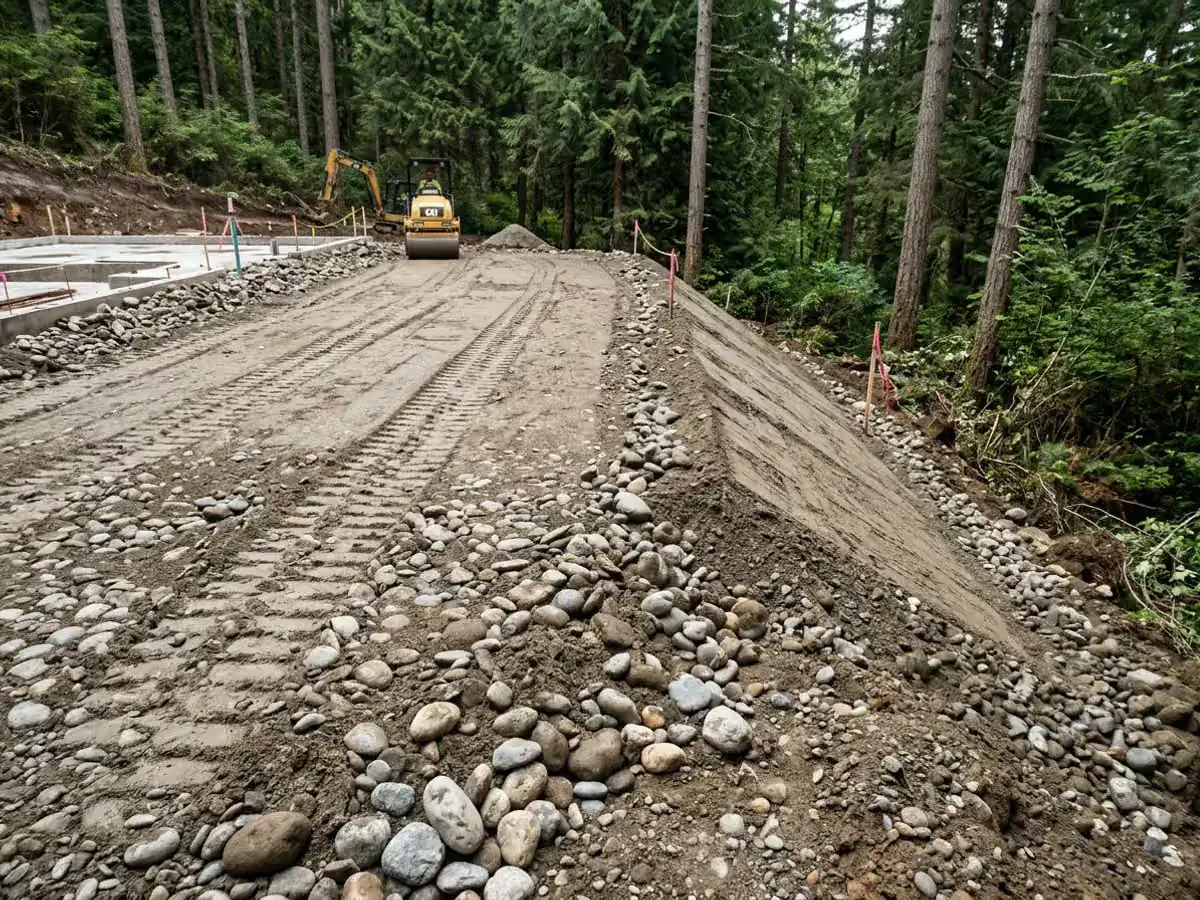
How Pit Run & Fill Gravel Performs
Ice-age glaciers left massive sand-and-gravel outwash deposits across Snohomish, King, Skagit, and Kitsap counties, making natural "pit run" (or WSDOT Gravel Borrow) abundant and budget-friendly. Unlike quarry basalt blasted from solid ledge rock and crushed sharp, pit run is excavated straight from glacial gravel banks as a well-graded mix of smooth rounded cobbles, pebbles, and coarse sand.
When you need 40 to 200+ tons of non-shrinking structural fill to raise the low side of a sloped detached-shop pad by two feet or backfill deep stump craters, pit run compacts to high structural density at far lower cost than crushed quarry basalt. However, because glacial pebbles are smooth and round, naked pit run on a driveway surface rolls like ball bearings under tires and must be capped with fractured 5/8"-minus rock.
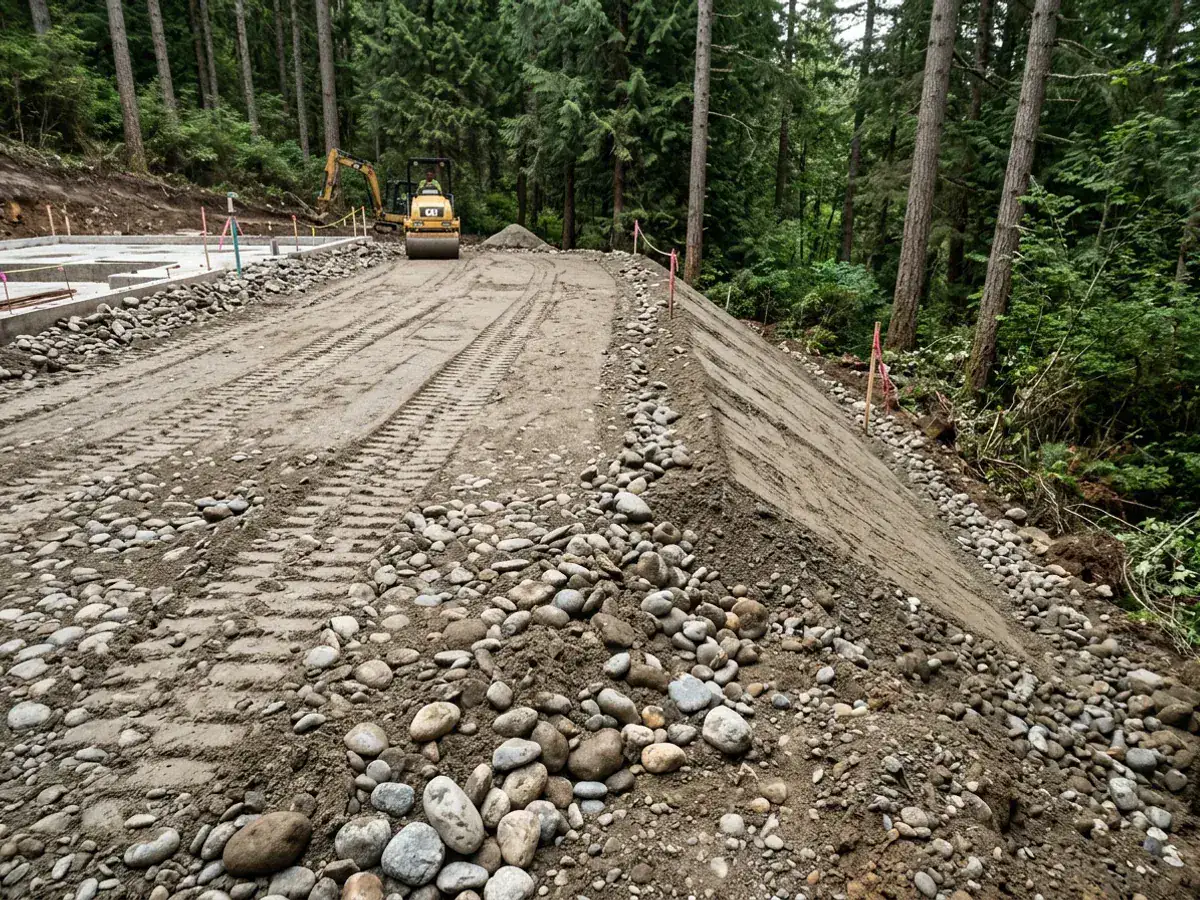
Common WA Gradations & Blends
Local pits and landscape yards stock a few closely related sizes within this family - here is how each option behaves on site.
Raw Pit Run / Bank-Run Gravel
Lowest cost per ton for deep pad raises (>12"), deep hole backfill, and rural timber road embankments.
Screened 2"-Minus / 3"-Minus Pit Run ("Select Borrow")
Removes oversized bowling-ball cobbles so 6-inch lifts grade and compact cleanly under slabs and trenches.
Crusher-Run / Fractured Gravel Borrow
Mid-tier hybrid offering better surface bite than round pit run while keeping sand-gravel economy.
Where to Use & Where to Avoid
Matching pit run & fill gravel to the right layer prevents ruts, plugged French drains, and wasted quarry deliveries.
Best Applications
- Raising elevation on sloped shop, garage, barn, and DADU building pads in compacted 6" lifts
- Structural non-settling backfill in deep stump excavation pits, demolished pool voids, and utility cuts
- Thick economical embankment sub-bases under long rural farm and acreage access roads
- Building firm structural berms, ramp approaches, and driveway shoulder backing
- Winter-workable all-weather structural fill ("all-weather gravel borrow" with <5% silt)
Not Ideal For / Avoid
- Uncapped top driving surface on driveways (round river pebbles roll loose, scatter into grass, and washboard)
- Thin 2-to-3-inch driveway skim coats (oversized bank cobbles stick up proud and kick under tires)
- Perforated French drain pipe surround (sand matrix migrates through pipe slots unless washed clean)
- Planting lawns or shrubs directly into pit run without 4+ inches of screened topsoil above it
Sample Coverage & Tonnage
Use these typical Western Washington footprints (including standard roller compaction allowance) to gauge rough volume before your exact quote.
| Sample Project Size | Target Depth | Estimated Volume & Weight |
|---|---|---|
| Backfilling 4 Large Uprooted Stump Craters | 24"-30" compacted lifts | ~10 cu yds (~14 tons) |
| 30 ft x 40 ft Sloped Shop Pad Build-Up | 18" average raise | ~67 cu yds (~90 tons + 4" crushed cap) |
| 14 ft x 200 ft Rural Road Embankment Fill | 12" compacted sub-base | ~104 cu yds (~140 tons) |
Need Pit Run & Fill Gravel Installed?
Send 2 to 4 photos of your driveway, pad, or yard along with rough measurements. We calculate exact tonnage, coordinate delivery, grade to spec, and compact in lifts.
Western WA Field Rules
Glacial clay, 9 months of drizzle, and county critical-area buffers change how aggregates perform here compared to dry climates.
Why Excavated Backyard Dirt Cannot Support a Slab
Homeowners often ask to reuse stripped lawn dirt to raise a garage pad. Native WA organic soil and wet clay sponge up water, swell, and settle unevenly - cracking concrete. Clean granular pit run compacts immediately to 95% structural density.
Winter Fill Spec (<5% Fines)
During damp October-April earthwork, high-clay fill dirt turns to slop under a roller. Clean sandy pit-run gravel borrow drains excess rain while still compacting tight.
Always Budget a 3"-4" Crushed Cap
Stop your pit-run fill 3 to 4 inches below final pad or driveway elevation, then finish with fractured 5/8"-minus basalt so concrete forms set dead-flat and tires never spin.
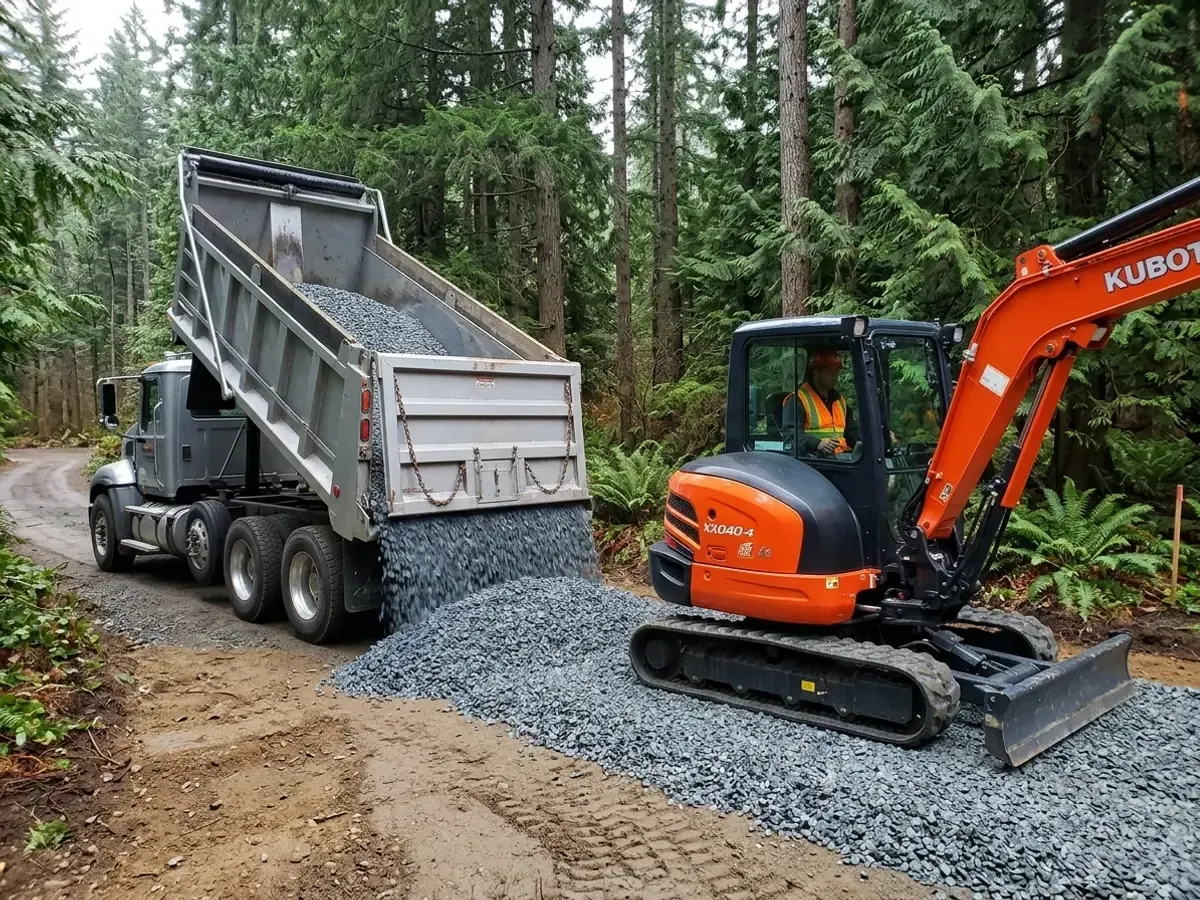
How We Grade & Compact It
Even top-grade quarry material fails if dumped directly onto sod or spread too thick without lift compaction. Here is how Clear Grade installs pit run & fill gravel:
- Strip all sod, roots, and black organic topsoil down to firm native mineral ground before placing any fill.
- Bench into sloped hillsides so the new pit-run embankment keys horizontally into native ground rather than sliding.
- Spread pit run in controlled 6-inch lifts, culling aside any cobbles larger than 3 to 4 inches near final grade, and compact each lift with a vibratory roller or plate/rammer.
- Cap driving or slab surfaces with 3 to 4 inches of fractured 5/8"-minus crushed rock.
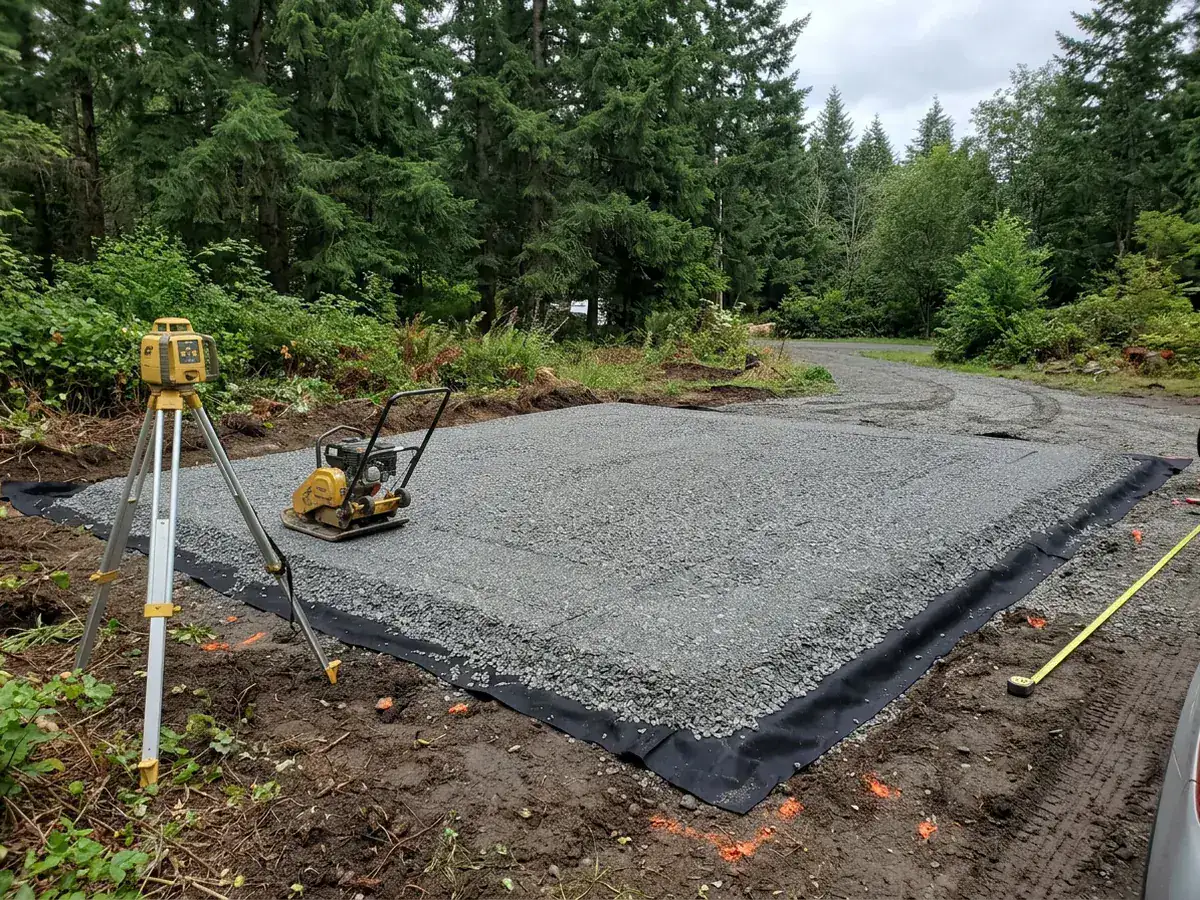
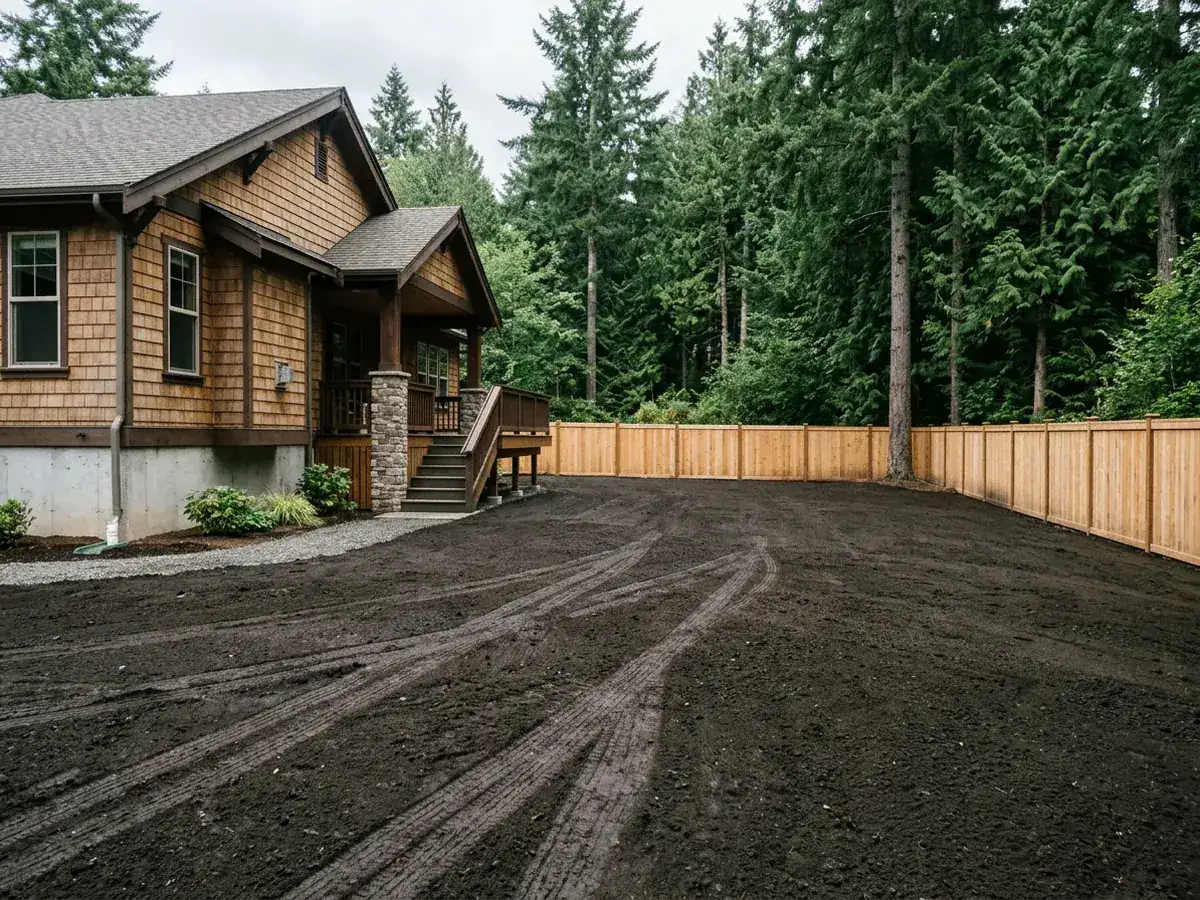
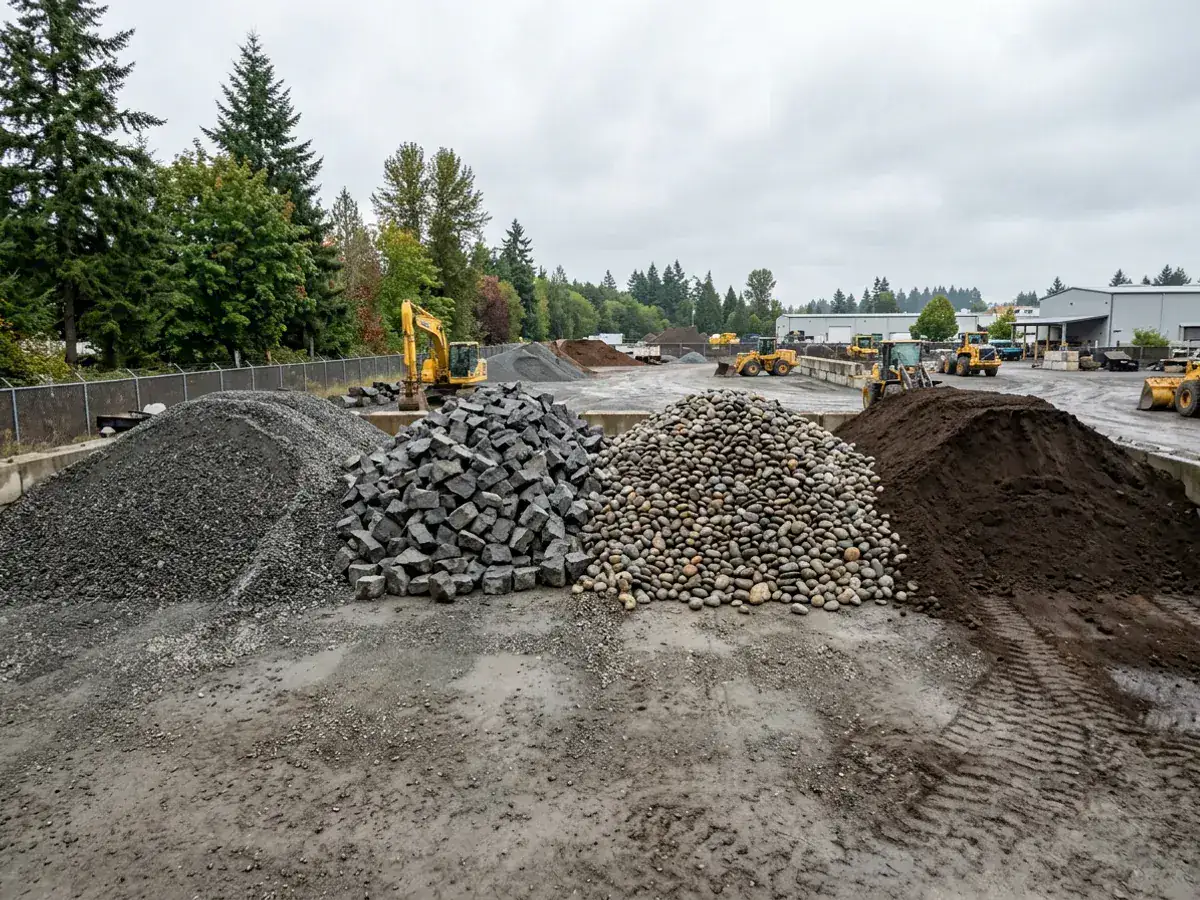
Field & Material Reference Photos
Representative Pacific Northwest equipment, aggregate, and finish examples showing typical site conditions and Clear Grade work standards.
Pit Run & Fill Gravel FAQs
Why can't I use excavated backyard dirt instead of pit-run gravel to build up a shop pad?
Native Western Washington topsoil contains decaying roots and silt/clay that hold water and compress over years - cracking slabs and tilting sheds. Granular sand-and-gravel pit run locks to structural bearing capacity the day it is compacted.
What is the difference between pit run and 5/8"-minus crushed rock?
Pit run is uncrushed round glacial gravel mixed with natural sand straight from the pit; 5/8"-minus is solid quarry basalt mechanically crushed so every face is sharp and locks into a smooth crust.
Can an existing pit-run farm lane be upgraded without digging it out?
Yes! Provided the pit-run base is thick and free of mud pumping, we scarify the top 2 inches, shape a 3% crown, and roller-compact a 3-to-4-inch cap of angular 5/8"-minus crushed basalt to lock the surface down.
Does pit run contain big boulders?
Raw unscreened pit run occasionally includes 6-to-10-inch cobbles. For trenches and shallower pad lifts, we order 2"-minus or 3"-minus screened pit run so every lift grades fast and uniform.
Is pit run good for filling deep stump holes under a future driveway?
It is one of the best choices: we compact pit run in 6-inch lifts up to subgrade height, then finish with 1-1/4"-minus and 5/8"-minus crushed rock so the old stump spot never sinks.