
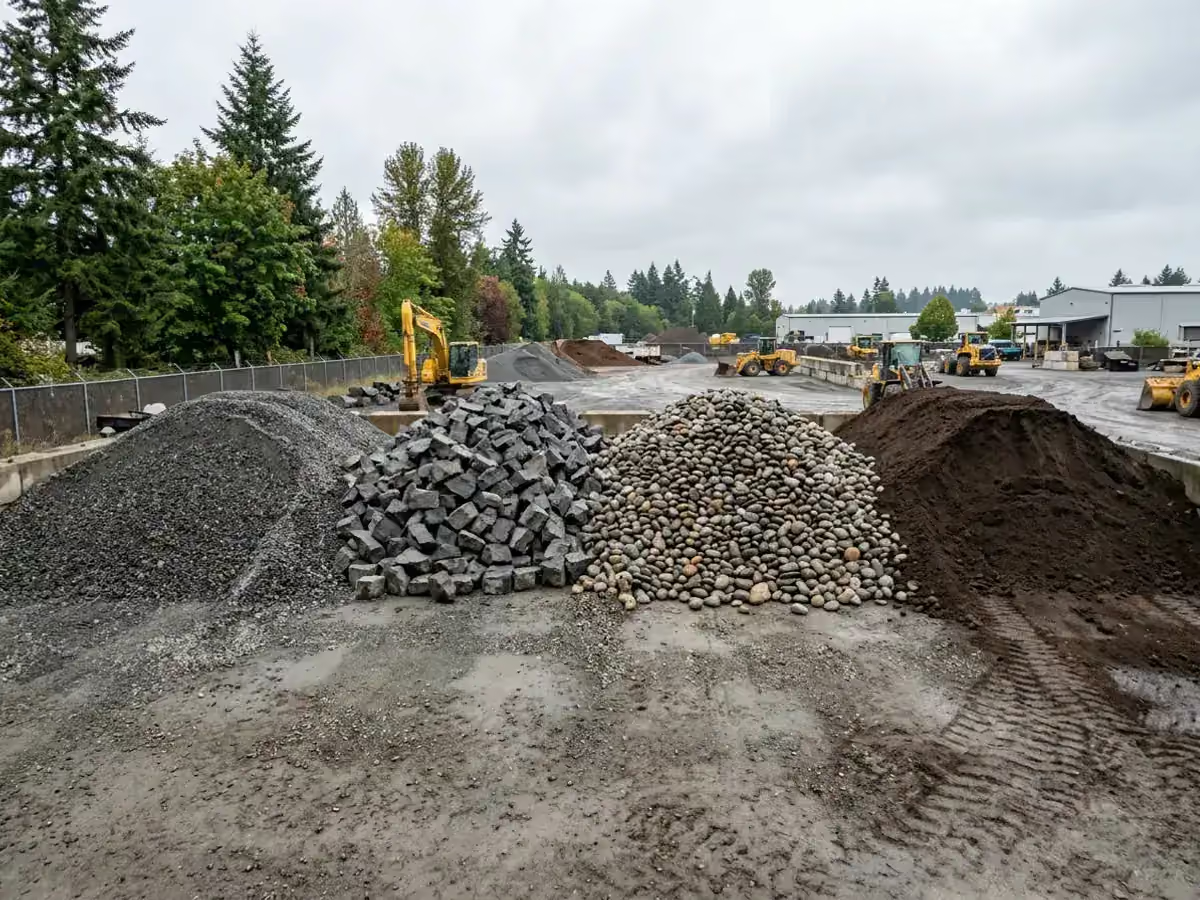
Match Material to Soil & Load
Not every driveway, building pad, or soggy yard needs the same stone. Dumping the wrong gravel onto saturated Western Washington glacial clay wastes truckloads of rock and shortens surface life.
The goal is never just dumping loose rock on mud. The goal is matching angular stone size, mineral fines, separation fabric, and vibratory roller compaction to your exact soil, slope, and axle load.
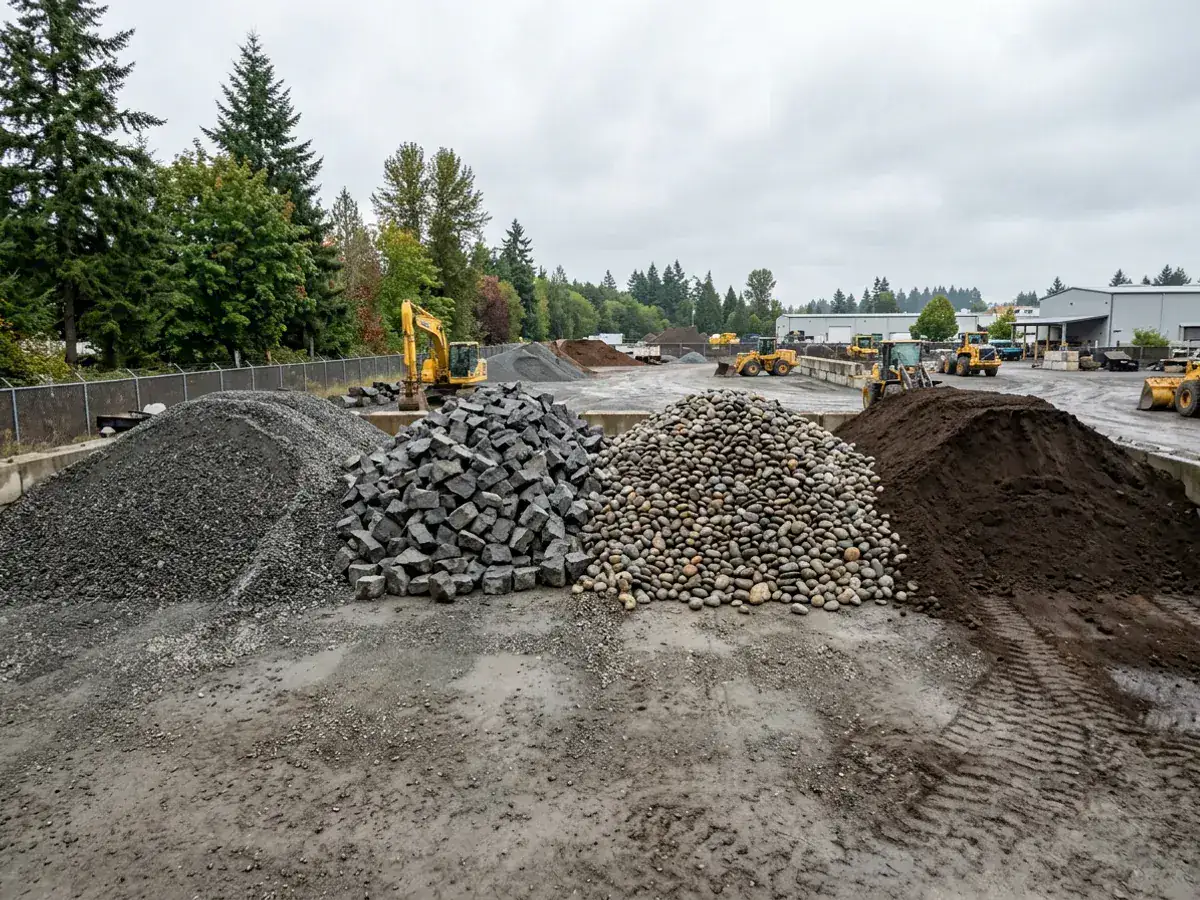
8 Aggregates, Soils & Mulches
Inspect real texture, stone size, compaction specs, and field installation rules for every primary bulk material we supply and grade across Snohomish and King counties.
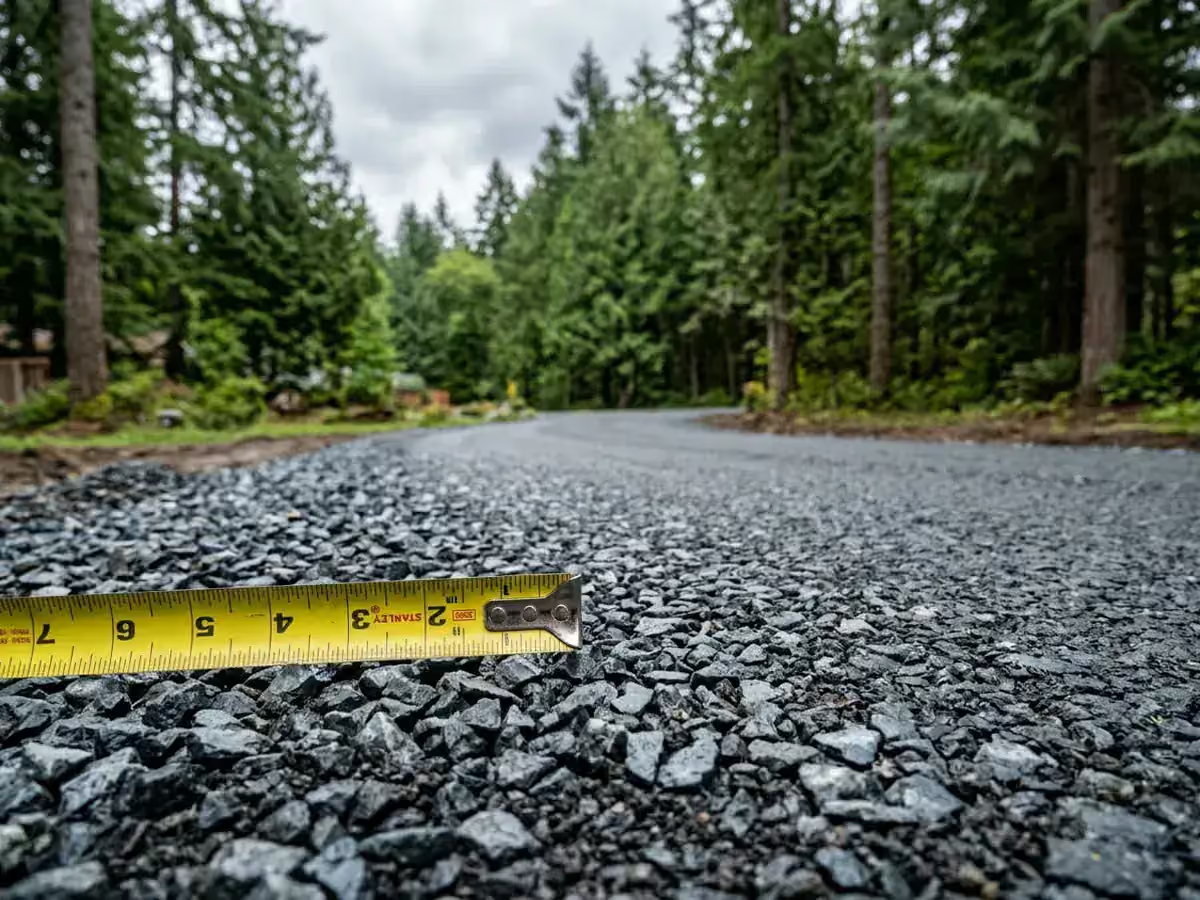
5/8"-Minus Crushed Rock
WSDOT Crushed Surfacing Top Course (CSTC) | ~1.40 tons / compacted cu ydWestern Washington's #1 top-course aggregate for gravel driveways, residential parking stalls, laser-leveled shed pads, and compactable walkways.
1-1/4"-Minus Base Rock
WSDOT Crushed Surfacing Base Course (CSBC) | ~1.42 tons / compacted cu ydHeavy-duty fractured structural base aggregate engineered to carry dump trucks, RVs, detached shop slabs, and full-depth gravel driveways without rutting.
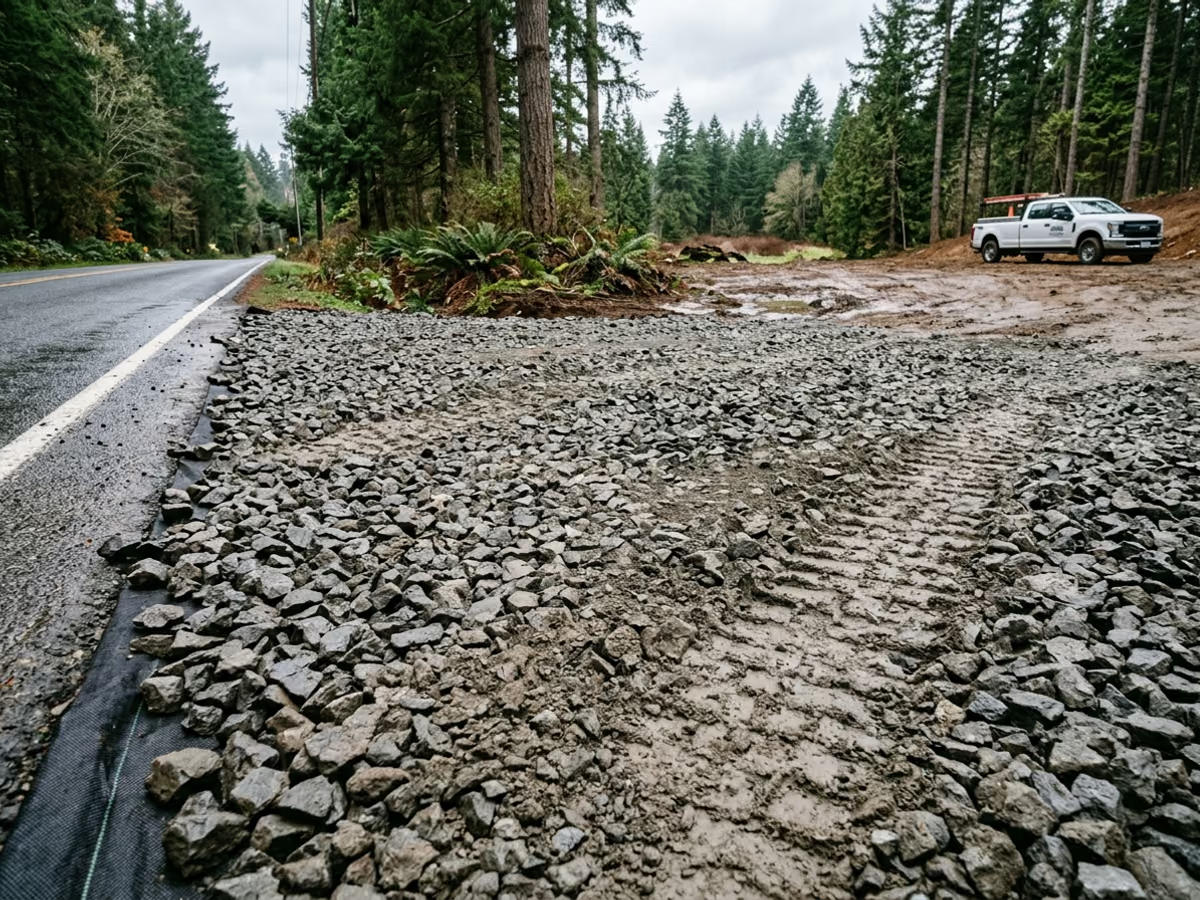
Quarry Spalls (2"-8")
WSDOT Quarry Spalls (2"-4" / 4"-8" Basalt) | ~1.35 tons / cu ydChunky 2-to-8-inch jagged fractured basalt engineered to conquer bottomless Puget Sound winter mud, pass county construction-entrance inspections, and armor ditches.
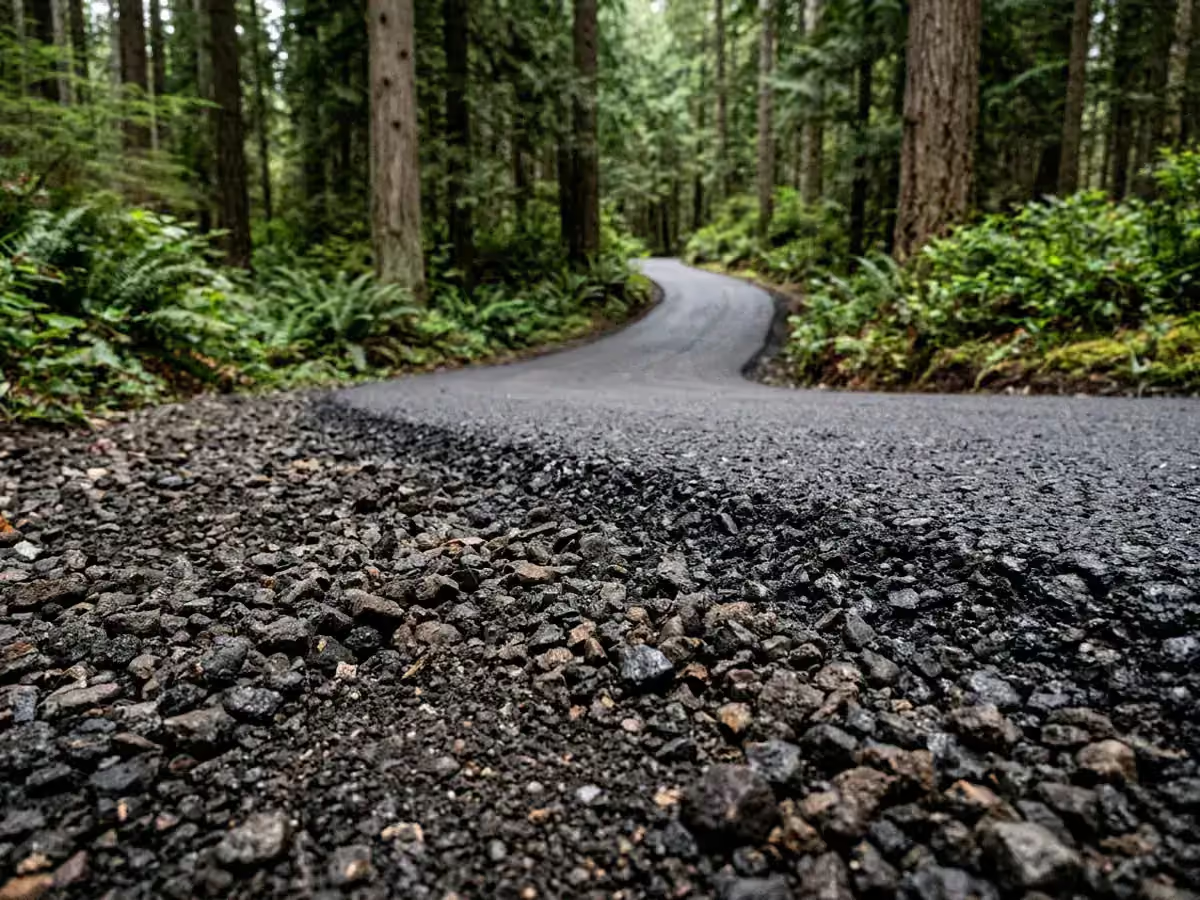
Asphalt Millings (RAP)
Screened 3/4"-Minus Reclaimed Asphalt Pavement (RAP) | ~1.25 tons / compacted cu ydScreened reclaimed highway asphalt that rolls into a dark, low-dust, semi-bound surface - delivering rustic blacktop curb appeal at a fraction of hot-mix paving cost.
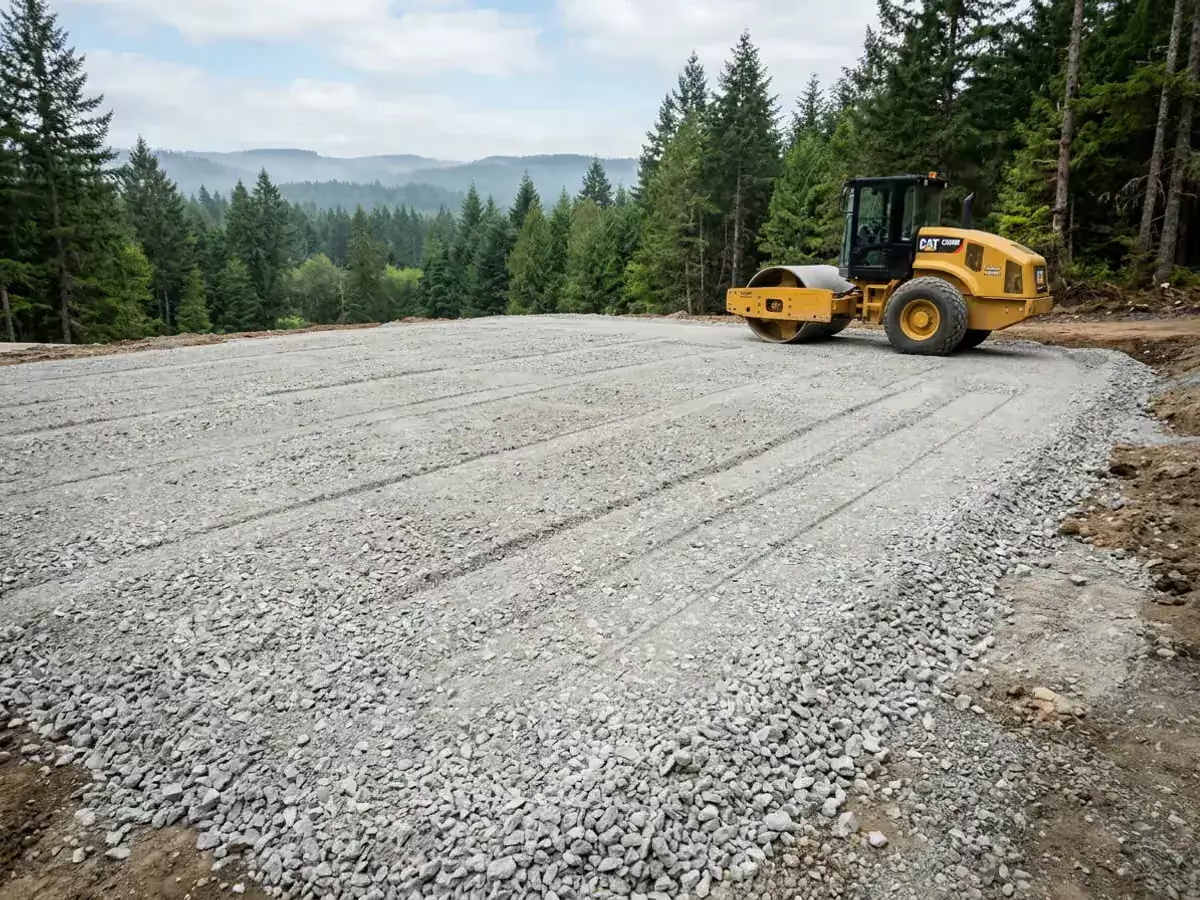
Recycled Crushed Concrete
Recycled Concrete Aggregate (1-1/4"-Minus / 5/8"-Minus) | ~1.28 tons / compacted cu ydClean demolished structural concrete crushed into sharp aggregate and self-binding cement dust - delivering rock-hard sub-bases and 20% to 35% material savings.
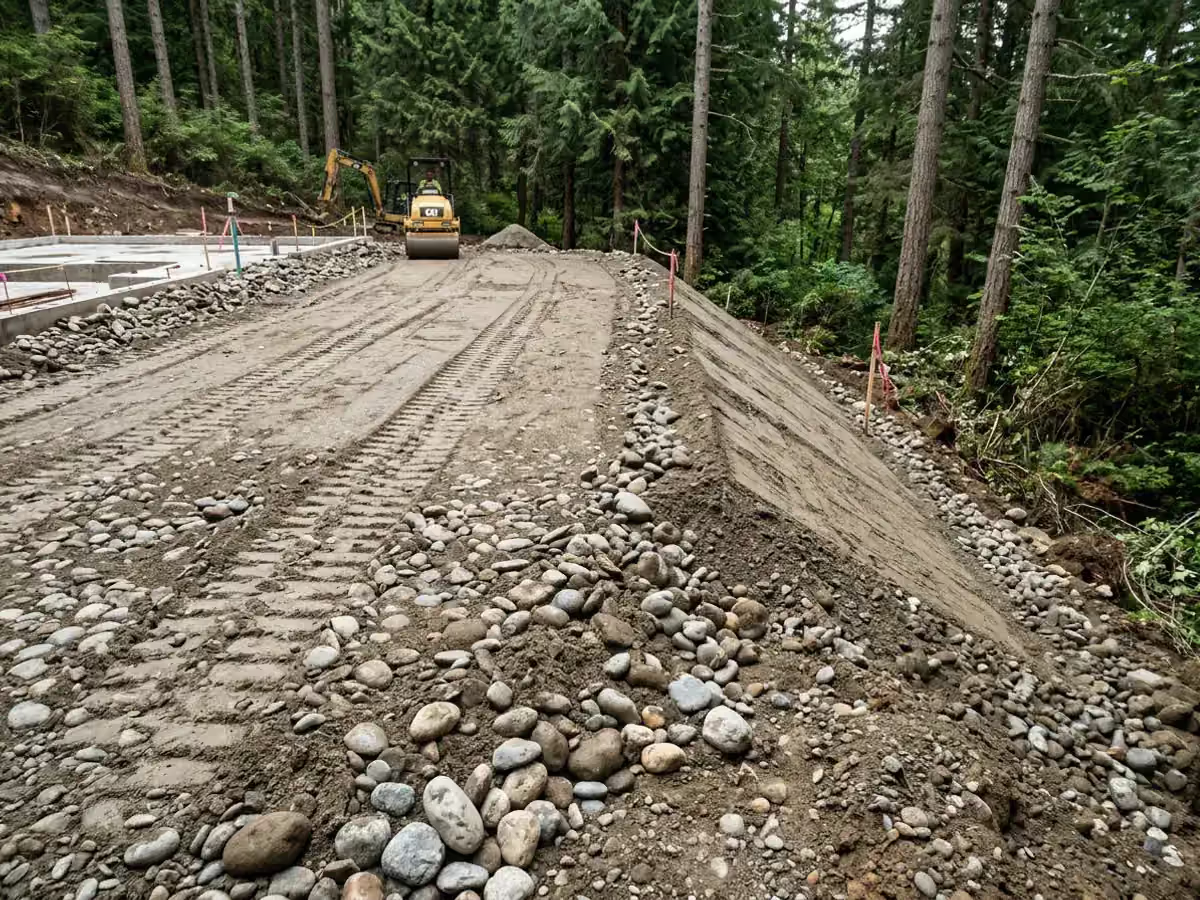
Pit Run & Fill Gravel
Gravel Borrow / Bank-Run Structural Fill | ~1.35 tons / compacted cu ydNatural Puget Sound glacial sand-and-gravel bank blend built for raising sloped building pads, deep stump/utility backfill, and thick rural road sub-bases.
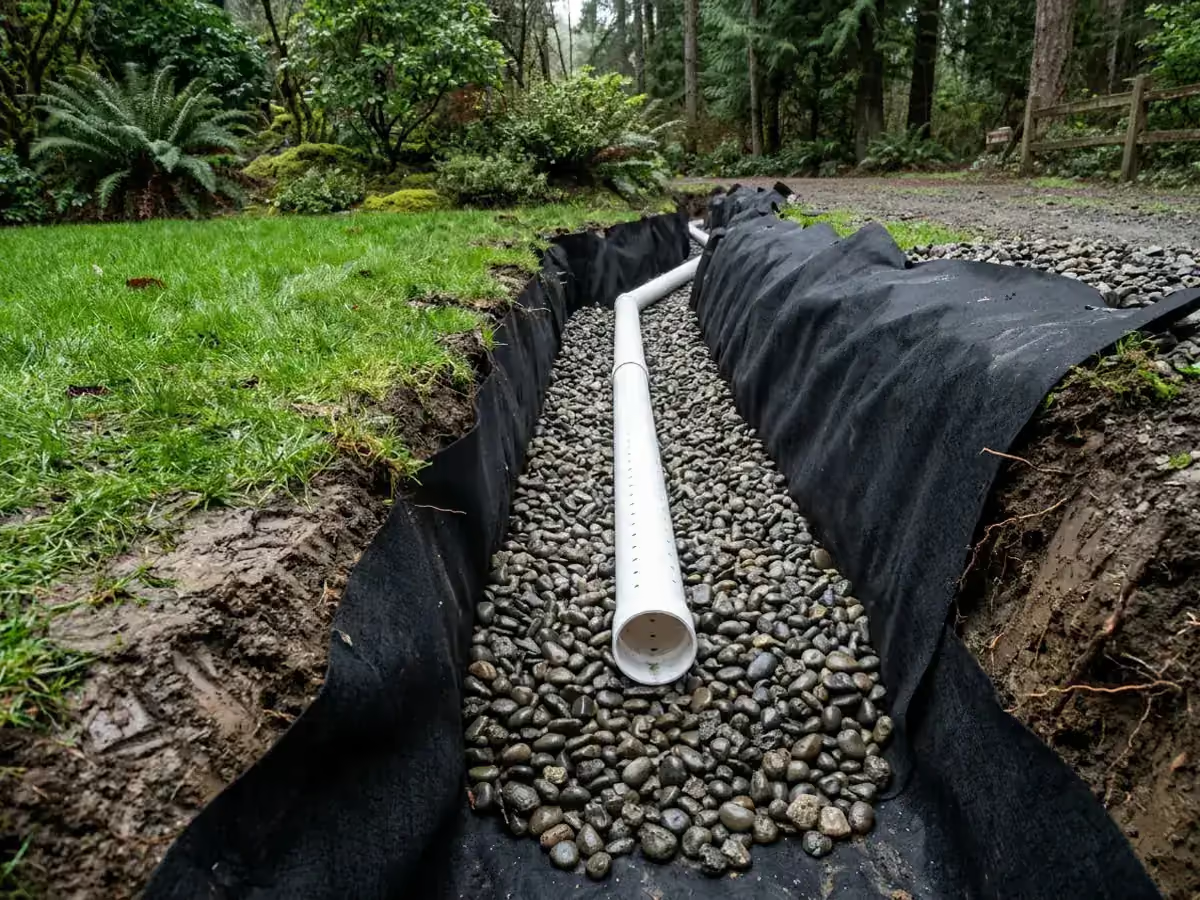
Washed Drain Rock & Pea Gravel
WSDOT Gravel Backfill for Drains / Clean Open-Graded | ~1.28 tons / cu yd100% dust-free washed stone engineered for high-volume groundwater flow in French drains, retaining walls, and dry wells - plus why clean rock ruins driveways.
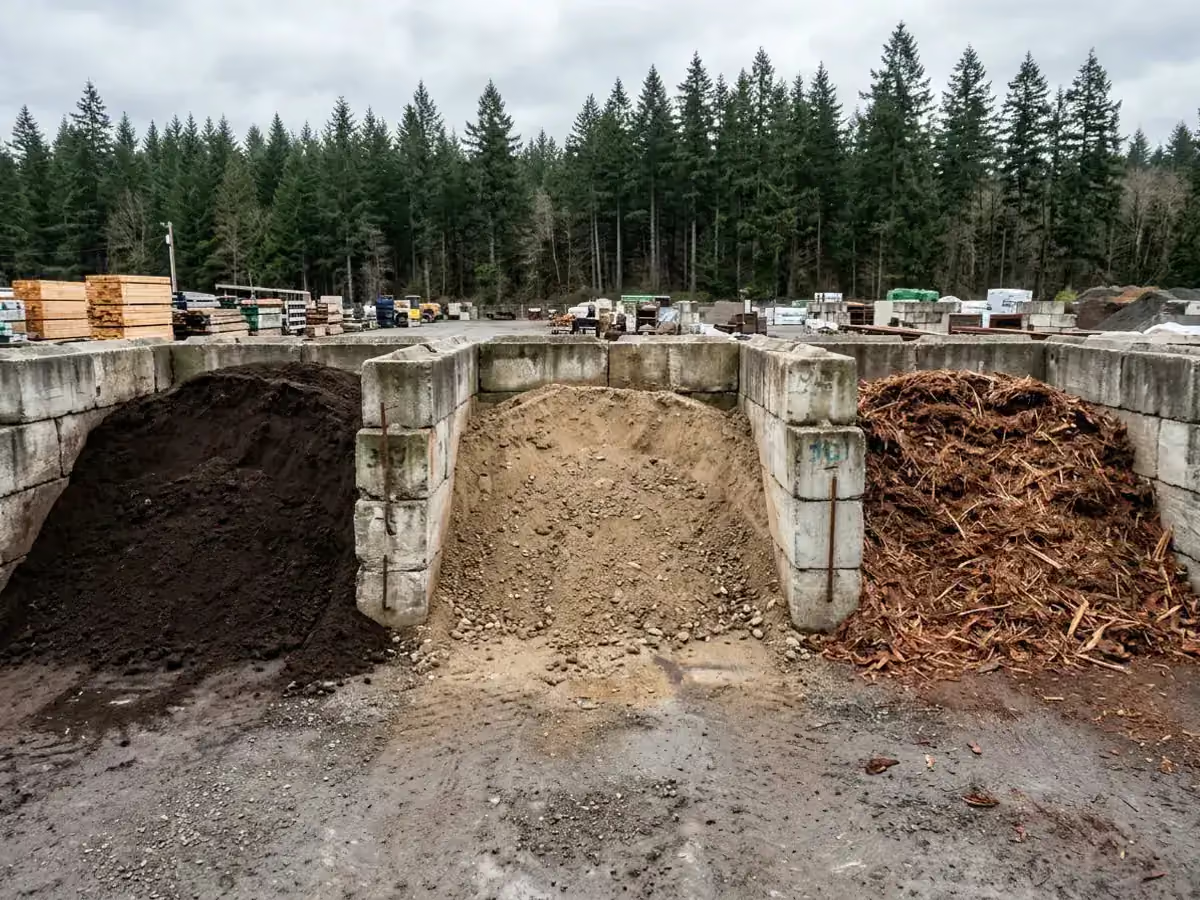
Topsoil, Fill & Wood Mulch
Screened Sandy Loam / Mineral Borrow / Arborist Hog Fuel | Topsoil ~1.1 tons/yd; Fill ~1.25 tons/yd; Mulch ~0.35 tons/ydKnow the critical engineering difference between sandy-loam lawn topsoil, compactable mineral fill dirt, and coarse fibrous hog-fuel mulch before spreading 20 yards.
"-Minus" Fines vs "Clean" Stone
Half of failed DIY gravel orders come down to one quarry word: "-minus" (contains stone dust that locks hard) versus "clean / washed" (zero dust for water flow).
Crushed "-Minus" Rock (With Fines)
Every stone is mechanically fractured with sharp corners and blended right down to fine rock dust. When misted with water and rolled, the fines lock the angular chips into a dense, rigid crust that sheds rain off a 2% to 4% crown.
Washed "Clean" Stone (Zero Fines)
All sand, silt, and quarry dust are washed away, leaving open channels between stones so Puget Sound winter groundwater rushes straight through into collection pipes without clogging.
4-Layer WA Driveway & Pad System
Long-lasting gravel driveways, RV stalls, and detached shop pads work as an engineered stack - never a single dump of loose stone onto sod.
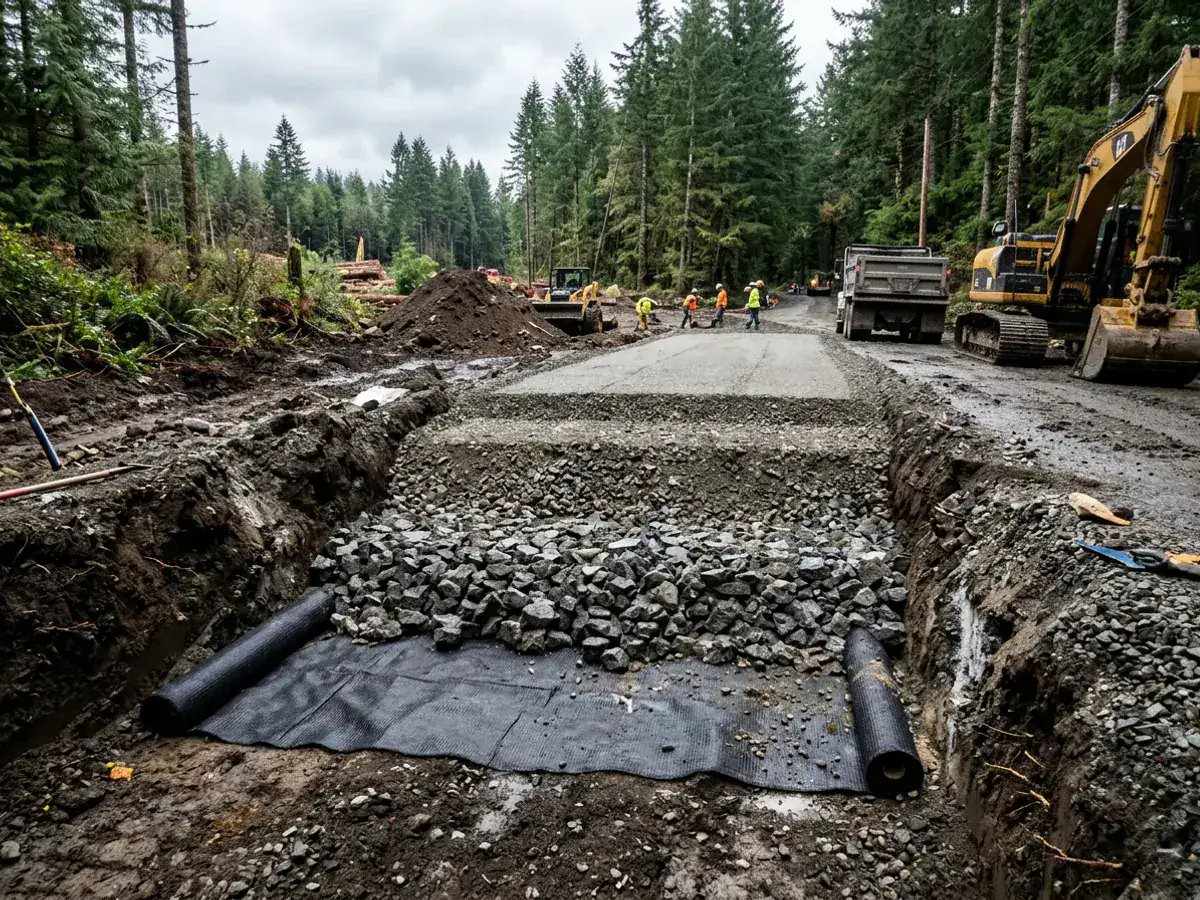
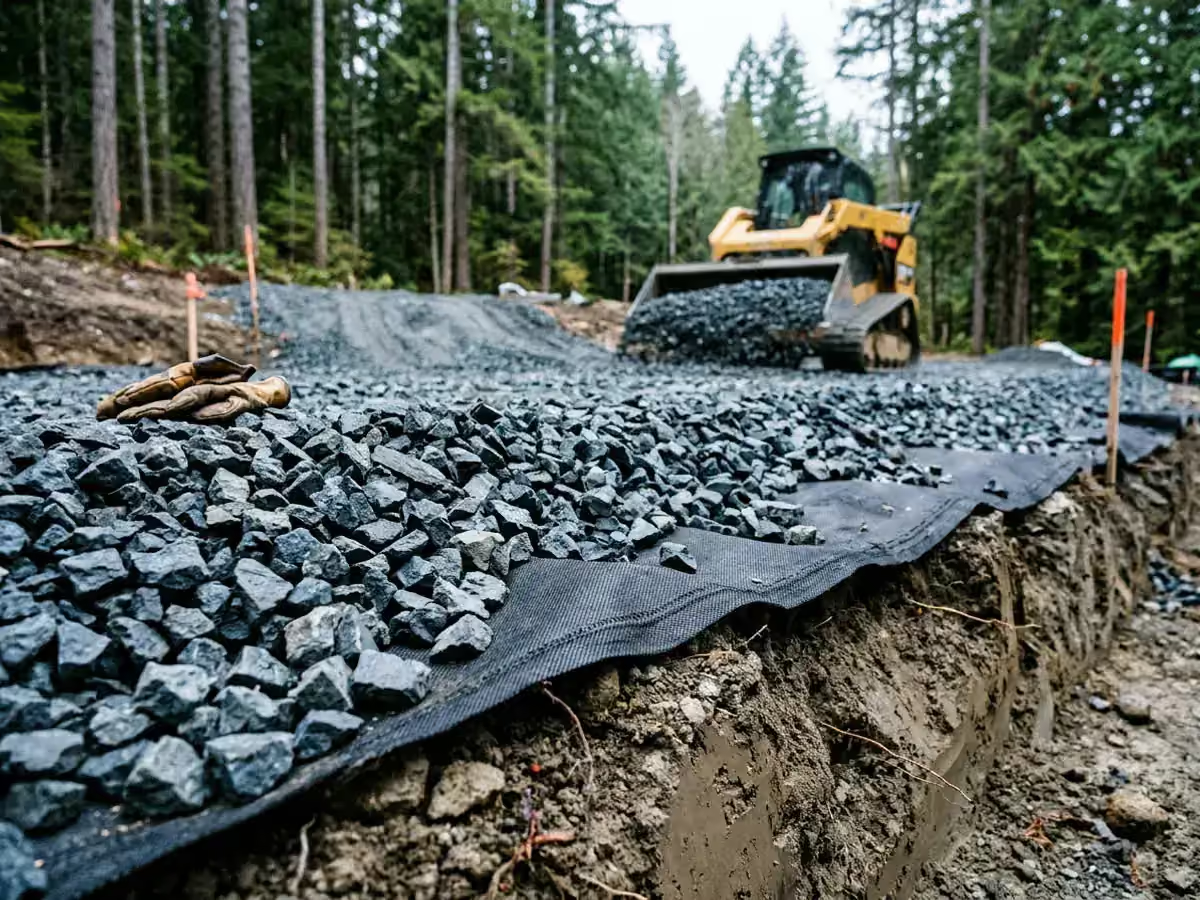
Stripped Subgrade & Geotextile
Woven stabilization fabric (200-300 lb tensile)Strip sod, forest duff, and spongy black topsoil down to firm native mineral ground, then roll out geotextile fabric with 18-to-24-inch overlaps so wet clay never pumps upward into clean stone.
Soft-Spot Mud Armor (When Needed)
6"-10" of 2"-4" or 4"-8" Angular Quarry SpallsOver saturated clay pockets, construction entrances, or culvert crossings, fist-sized jagged basalt wedges into a rigid stone skeleton that bridges bottomless winter mud.
Structural Base Lift
4"-6" of 1-1/4"-Minus Base Rock or Crushed ConcreteCoarse fractured base aggregate interlocks under vibratory drum roller passes to distribute heavy dump-truck, RV, and concrete-slab loads without rutting.
Compacted Wearing Surface
3"-4" of 5/8"-Minus Basalt or Asphalt MillingsTightly graded top course shaped with a 2% to 4% crown, moisture-conditioned, and rolled smooth so rainwater sheets directly into roadside ditches.
Recommended Build-Ups by Job Type
Match your project directly to the subgrade prep, base stone, finish cap, and compacted thickness we build in Western Washington.
| Project Scenario | Subgrade & Fabric | Base Layer | Top / Finish Layer | Target Depth |
|---|---|---|---|---|
| Existing Gravel Driveway Top-Up (Solid Base) | Rip potholes full-depth & reshape 3% crown | Existing compacted roadbed | 3"-4" of 5/8"-Minus Basalt (or RAP) | 3"-4" fresh lift |
| New Residential Driveway (Firm Glacial Till) | Strip sod/topsoil + woven geotextile | 4"-6" of 1-1/4"-Minus Base Rock | 3" of 5/8"-Minus Crushed Basalt | 7"-9" compacted |
| Wet Clay / Soft Winter Access Road | Subgrade cut + heavy woven fabric + side ditch | 6"-8" of 2"-4" Spalls + 4" of 1-1/4"-Minus | 3" of 5/8"-Minus Crushed Basalt | 13"-15" compacted |
| RV, Boat Trailer, or Heavy Truck Pad | Strip organics + woven road fabric | 5"-6" of 1-1/4"-Minus or Crushed Concrete | 3" of 5/8"-Minus Basalt or Millings | 8"-9" compacted |
| Prefab Shed, Greenhouse, or Hot-Tub Pad | Level bench cut + timber border + fabric | Single or split structural lift | 4"-6" laser-leveled 5/8"-Minus Basalt | 4"-6" compacted |
| County Construction Entrance (New Build) | Strip mud + heavy woven stabilization fabric | 8"-12" of 4"-8" or 2"-4" Quarry Spalls | Cap later with 5/8"-Minus before move-in | 8"-12" spall pad |
| French Drain & Retaining Wall Backfill | 1%+ laser trench pitch + non-woven filter wrap | Rigid SDR-35 perforated PVC pipe (holes down) | 1-1/2" Washed Drain Rock (burrito-wrapped) | 12"-24" trench section |
| Lawn Re-Grading & Woodland Mud Trails | Rough grade 1%-2% slope away from house | Compacted Pit Run / Mineral Fill (deep lows) | 3"-4" Sandy-Loam Topsoil (or 5" Hog Fuel on trails) | 3"-6" finish lift |
8-Material Technical Matrix
Compare WSDOT gradation, unit weight per cubic yard, compaction behavior, and best vs wrong applications across all 8 bulk categories.
| Material | Gradation & Density | Compaction | Best Used For | Avoid Using For |
|---|---|---|---|---|
| 5/8"-Minus Crushed Rock3" to 4" compacted lift (4"-6" on shed pads) | 5/8" (16 mm) fractured basalt down to #200 dust~1.40 tons / compacted cu yd (~105 lbs/cu ft) | Locks into a smooth, dense, water-shedding crust | Top wearing surface (final 3"-4" cap) on residential gravel driveways and private roads | French drains, footing drains, or dry wells (the stone dust clogs perforated pipe and filter fabric) |
| 1-1/4"-Minus Base Rock4" to 8" compacted (placed in 4"-5" lifts) | 1-1/4" (31.5 mm) fractured rock down to fines~1.42 tons / compacted cu yd (~106 lbs/cu ft) | Interlocks into a rigid heavy-axle structural mat | Primary structural base layer under new gravel driveways and rural access lanes | Barefoot lawn walkways or decorative garden paths (1.25" angular stones feel coarse underfoot unless capped) |
| Quarry Spalls (2"-8")6" to 12"+ keyed over heavy geotextile | 2"-4" small spalls or 4"-8" standard spalls~1.35 tons / cu yd (~100 lbs/cu ft in place) | Tracked/keyed in to bridge soft saturated clay | County-compliant TESC stabilized construction entrances on raw-land builds (stops mud tracking onto public roads) | Finished residential driveway surface (far too rough and sharp for passenger car tires unless choked and capped) |
| Asphalt Millings (RAP)3" to 4" compacted cap over firm rock base | Screened 3/4"-minus crushed reclaimed asphalt~1.25 tons / compacted cu yd (~93 lbs/cu ft) | Knits tighter over time under roller weight & sun | Long rural driveways, farm lanes, and shared private roads wanting minimal summer dust | Driveways inside regulated wetland buffers, lake shorelines, or salmon-bearing stream setbacks (use clean virgin 5/8"-minus basalt near waterways) |
| Recycled Crushed Concrete4" to 8" compacted structural base lift | 1-1/4"-minus structural base or 5/8"-minus cap~1.28 tons / compacted cu yd (~95 lbs/cu ft) | Sets up nearly slab-hard after misting & rolling | Budget-smart structural base layer beneath a virgin 5/8"-minus basalt finish cap | Showpiece front-entry topcoats where a dark Northwest basalt aesthetic is desired (crushed concrete dries light chalky gray) |
| Pit Run & Fill Gravel6" to 36"+ placed in compacted 6" lifts | Unscreened bank sand + rounded gravel/cobbles (2"-6" max)~1.35 tons / compacted cu yd (~100 lbs/cu ft) | Compacts dense in deep confined lifts; rolls loose on top | Raising elevation on sloped shop, garage, barn, and DADU building pads in compacted 6" lifts | Uncapped top driving surface on driveways (round river pebbles roll loose, scatter into grass, and washboard) |
| Washed Drain Rock & Pea Gravel12"-24" wrapped trench / 12"+ behind walls | 1-1/2" washed drain, 3/4" clean, or 3/8" pea gravel~1.28 tons / cu yd (~95 lbs/cu ft) | Non-cohesive open void matrix (never crusts) | French drains, hillside curtain/interceptor drains, and soggy lawn groundwater trenches | Gravel driveway topcoats or un-contained parking pads (vehicles sink, spin ruts, and fling stone into lawns) |
| Topsoil, Fill & Wood Mulch3"-4" lawn soil; 6"-12" garden beds; 4"-6" hog fuel | 1/2"-screened soil blends, mineral fill, or 2"-6" wood fiberTopsoil ~1.1 tons/yd; Fill ~1.25 tons/yd; Mulch ~0.35 tons/yd | Compact mineral fill hard; firm topsoil lightly (~80%) | 2-Way sandy loam: finish lawn grading (3"-4" depth) prior to sod rolls, hydroseeding, or overseeding | Placing topsoil, compost, or stump grindings underneath future driveways, concrete slabs, sheds, or retaining walls (organics decompose and settle inches!) |
Not Sure Which Rock or Tonnage Fits?
Send 2 to 4 photos of your driveway, pad, or muddy yard with rough length x width. Our operator will recommend the exact WA quarry spec, tonnage, and written fixed-price installation options (free review).
Tonnage, Coverage & Truck Guide
Washington rock quarries bill gravel by the ton, while landscape supply yards sell topsoil and wood mulch by the cubic yard. Always add 15% to 20% over raw math for roller compaction.
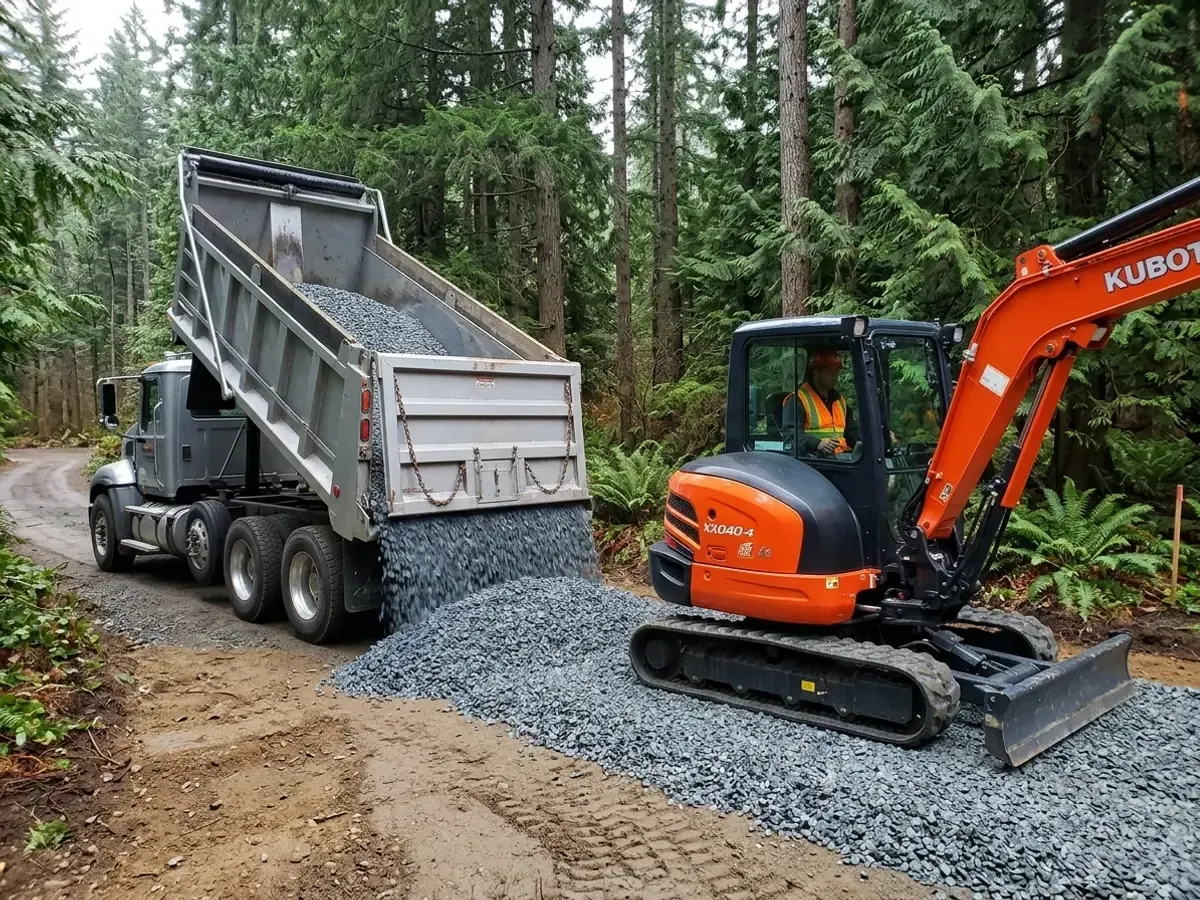
5/8"-Minus & 1-1/4"-Minus Basalt
Add 15%-20% compaction allowance over neat math
2"-4" & 4"-8" Quarry Spalls
Larger air voids; choke top with smaller base rock
Recycled Crushed Concrete
Slightly lighter per yard than solid WA basalt
Recycled Asphalt Millings (RAP)
Rolls down ~20% thinner from loose to compacted
1-1/2" Washed Drain Rock
Minimal compaction shrinkage; ~40% void space
2-Way Topsoil / Wood Hog Fuel
Topsoil ~1.1 tons/yd; hog fuel ~700 lbs/yd
| Sample Footprint | Compacted Depth | Est. Volume | Quarry Order (+18%) | Typical Delivery |
|---|---|---|---|---|
| 10 ft x 16 ft Shed Pad | 4" compacted | ~2.4 cu yds | ~4 tons | 1 dump-trailer load |
| 12 ft x 36 ft RV / Boat Pad | 6" compacted | ~9.5 cu yds | ~14 tons | 1 solo dump truck |
| 12 ft x 100 ft Driveway Topcoat | 3" compacted | ~13 cu yds | ~18 tons | 1 solo 4-axle truck |
| 12 ft x 100 ft Full New Driveway | 8" (5" base + 3" top) | ~35 cu yds | ~49 tons | 3 solo loads or 1.5 truck & pup |
| 24 ft x 36 ft Detached Shop Pad | 6" compacted | ~19 cu yds | ~27 tons | 1 transfer / 2 solo loads |
| 14 ft x 250 ft Shared Road Rehab | 4" compacted | ~51 cu yds | ~72 tons | 2.5 truck-and-pup loads |
Tight-Access Dump Trailer
9.5 ft gate width, low tree canopy friendlyResidential side yards, thin concrete driveway crossings, French drain stone, and small shed pads.
Solo 3-Axle / 4-Axle Dump Truck
11 ft width + 16 ft overhead dump clearanceStandard residential driveways, garage pads, and medium road touch-ups without tight trailer turnarounds.
Truck & Pup / Transfer Dump
Wide rural road / staging pad requiredLowest trucking cost per ton for new acreage driveways, large shop pads, and HOA private road rehabs.
8 Factors We Check On Every Lot
Every parcel in Snohomish, King, Island, Kitsap, and Skagit counties combines a distinct mix of glacial till or soft clay, slope steepness, canopy shade, and tire weight.
Traffic & axle weight
Passenger cars, daily delivery vans, 12,000-lb boat trailers, Class-A RVs, and 60,000-lb concrete mixers require different base rock sizes and total depths.
Slope & hillside grade
Steep Snohomish and Eastside driveways shed round gravel fast; grades above 6% demand sharp fractured basalt with high fines or rolled asphalt millings.
Winter rain & runoff
Nine months of Northwest rain soften high-fines rock if water pools in flat spots instead of sheeting off a 2% to 4% crown into side swales.
Subgrade softness
Firm glacial hardpan accepts standard 4-to-6-inch base lifts, while wet clay, silt, or organic pockets demand woven geotextile fabric and coarse quarry spalls.
Fines vs washed stone
Aggregates labeled "-minus" pack tight into a traffic crust. Washed "clean" stone stays open for groundwater flow and never locks under tires.
Appearance & dust level
Virgin blue-gray WA basalt gives a clean Northwest finish, asphalt millings cure dark like rustic blacktop with minimal dust, and crushed concrete favors heavy utility.
Smart layer budgeting
Placing recycled 1-1/4"-minus crushed concrete or glacial pit run in the lower base lift under a 3-inch virgin 5/8"-minus cap lowers cost while keeping top curb appeal.
Critical-area rules
Parcels near wetlands, lakes, or salmon-bearing creeks require clean virgin basalt rather than recycled asphalt millings or high-pH fresh crushed concrete.
WA Quarry & WSDOT Spec Glossary
Plain-English definitions for the exact material names printed on Snohomish and King County quarry scale tickets.
WSDOT CSTC (5/8"-Minus)
Washington State DOT "Crushed Surfacing Top Course" - sharp 5/8-inch fractured rock blended down to stone flour for smooth, tight topcoats.
WSDOT CSBC (1-1/4"-Minus)
Washington State DOT "Crushed Surfacing Base Course" - coarser 1.25-inch angular rock engineered for heavy structural road and slab bases.
Quarry Spalls
Rough 2"-4" or 4"-8" blasted angular basalt chunks used to stabilize deep mud, armor ditches, and build county construction entrances.
Open-Graded / Clean Stone
Aggregate washed free of all sand and dust (e.g., 1-1/2" drain rock or 3/4" clean) so water passes rapidly through open voids.
Pit Run / Bank Run
Uncrushed natural glacial gravel, cobbles, and sand dug straight from a gravel bank - economical for deep structural fill, too round for topcoats.
Woven vs Non-Woven Geotextile
Woven tape fabric adds high tensile strength under driveways and pads; fuzzy needle-punched non-woven fabric filters water in French drains.
2-Way vs 3-Way Topsoil
2-Way mixes washed sand + composted loam for firm, mud-free WA lawns; 3-Way adds aged bark/compost richness for raised garden and shrub beds.
Hog Fuel
Coarse, long-strand shredded wood and bark fibers that interlock into a firm, mud-beating mat on wooded trails, gates, and livestock paddocks.
Field Material Reference Gallery
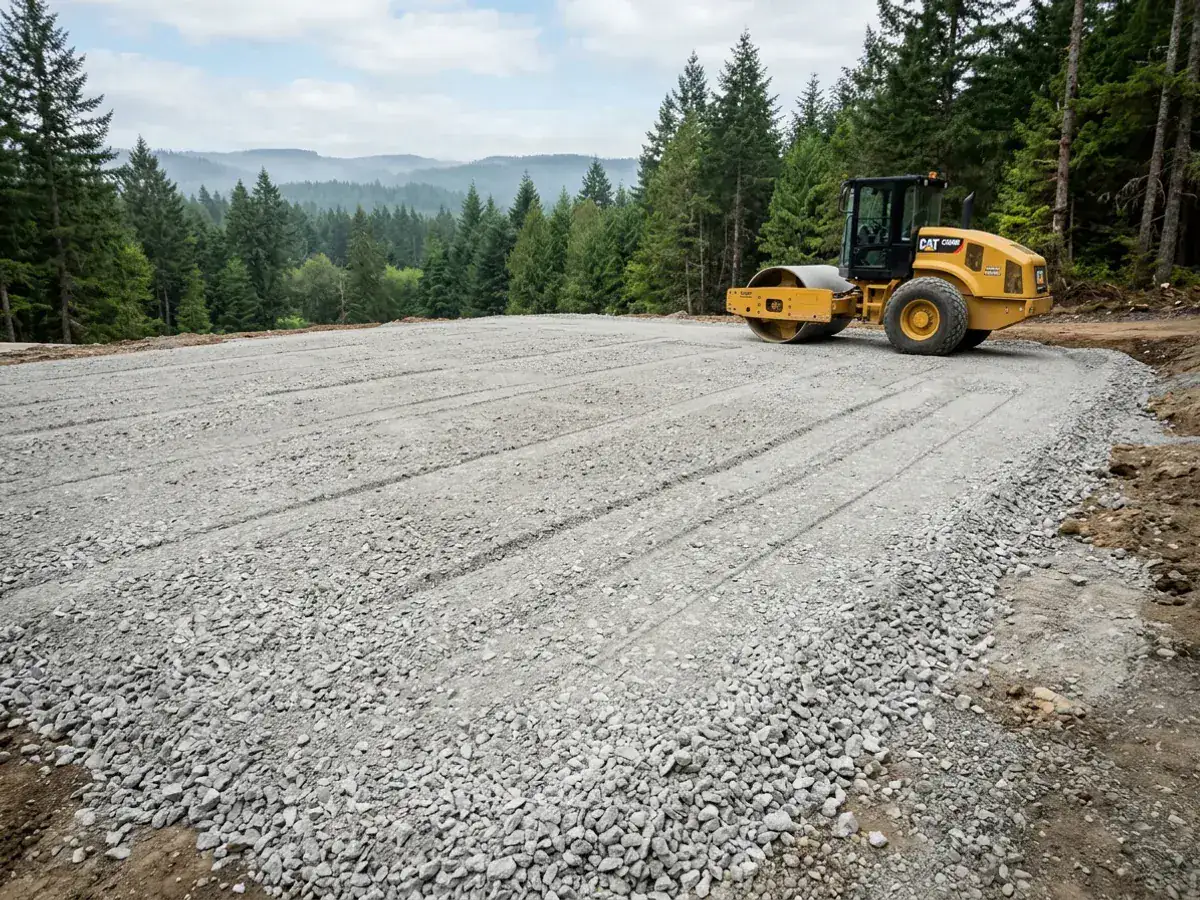
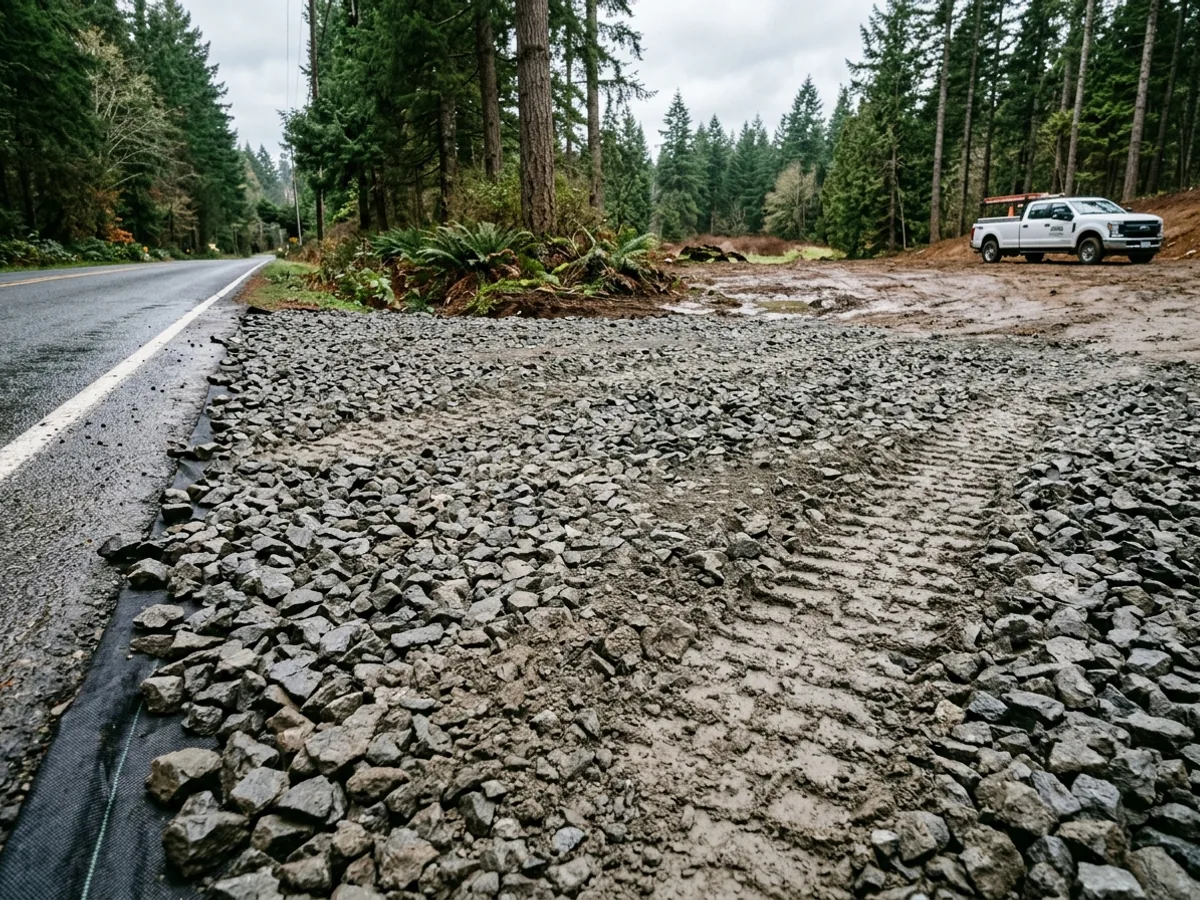
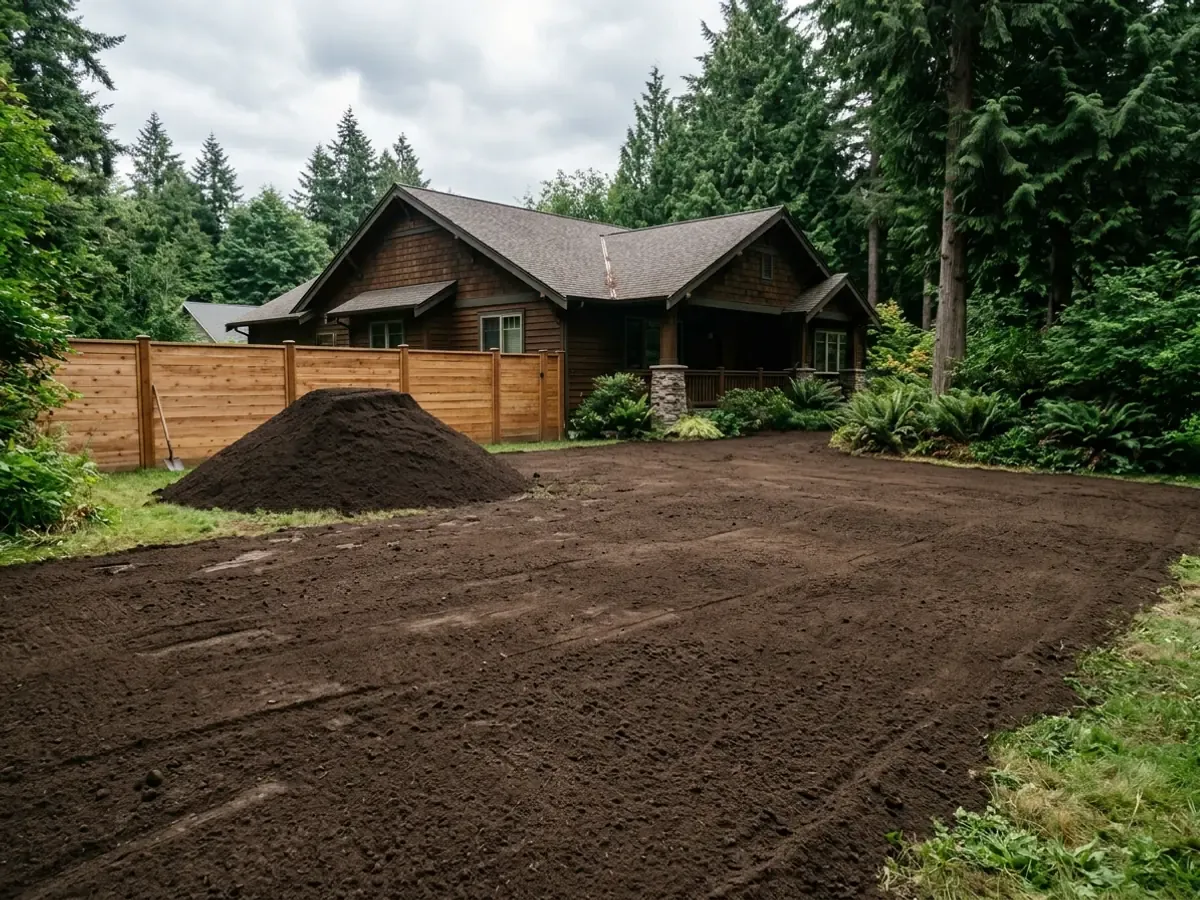
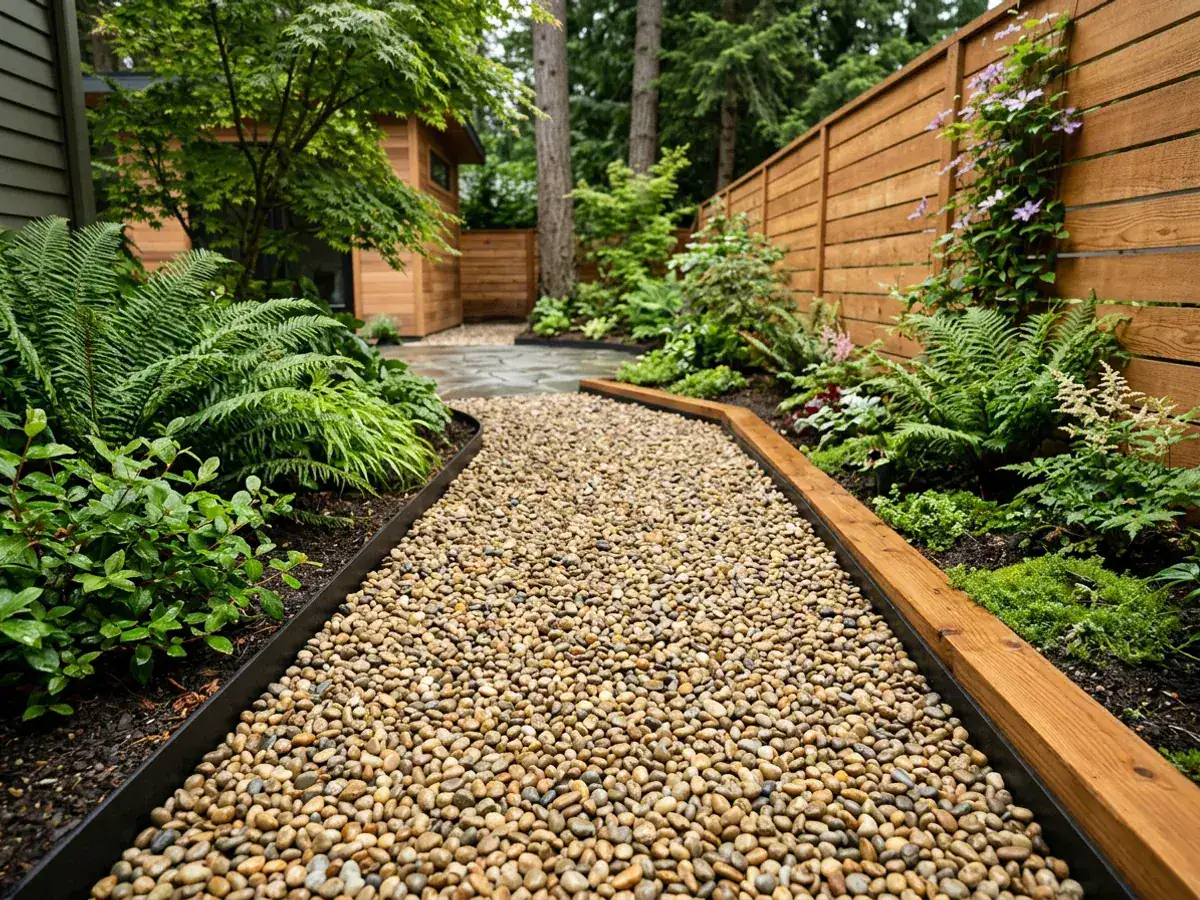
Representative Pacific Northwest equipment, aggregate, and finish examples showing typical site conditions and Clear Grade work standards.
Material & Tonnage FAQs
What is the best overall gravel for a Washington residential driveway?
For 90% of Snohomish and King County driveways, 5/8"-minus crushed basalt rock (WSDOT Crushed Surfacing Top Course) compacted over a 1-1/4"-minus structural base and woven geotextile fabric is the gold standard. Its fractured edges and stone dust lock into a tight, water-shedding crust.
Why did the fresh gravel I had dumped last year sink into mud?
Two common mistakes: either washed "clean" stone without fines was ordered (which shifts and lets rainwater straight down into clay), or new rock was dumped directly onto wet mud or unripped potholes without geotextile separation fabric, a 3% crown, and roller compaction.
How do I convert cubic yards to tons when ordering WA gravel?
Multiply compacted cubic yards by 1.40 for crushed basalt rock (5/8"-minus or 1-1/4"-minus), or ~1.28 for washed drain rock and crushed concrete. Always add 15% to 20% over raw length x width x depth math because loose rock compresses under a vibratory roller.
What is the difference between woven road fabric and landscape weed barrier?
Hardware-store weed barrier tears immediately under stone and tires. Commercial woven geotextile road fabric (200-300 lb tensile rating) separates wet Puget Sound clay from clean base rock for decades while reinforcing wheel loads.
Can dump trucks tailgate-spread gravel directly on my driveway?
Where overhead power lines and tree branches allow at least 16 to 18 feet of raised-bed clearance, skilled drivers can tailgate a rough lift - however, tailgate dumping alone never cuts potholes, shapes a drainage crown, or compacts rock. Machine grading and vibratory rolling make the surface last.
Does Clear Grade supply, haul, spread, and compact these materials?
Yes. We calculate exact quarry tonnage, coordinate commercial dump trucks or tight-access dump trailers, grade material to laser or crown spec, and compact structural lifts with vibratory smooth-drum rollers and plate compactors.